
How to read an MOT history properly
It's free, public and very hard to fake — and most buyers skim it for a pass and close the tab. Here's what the mileage readings and repeat advisories actually tell you.
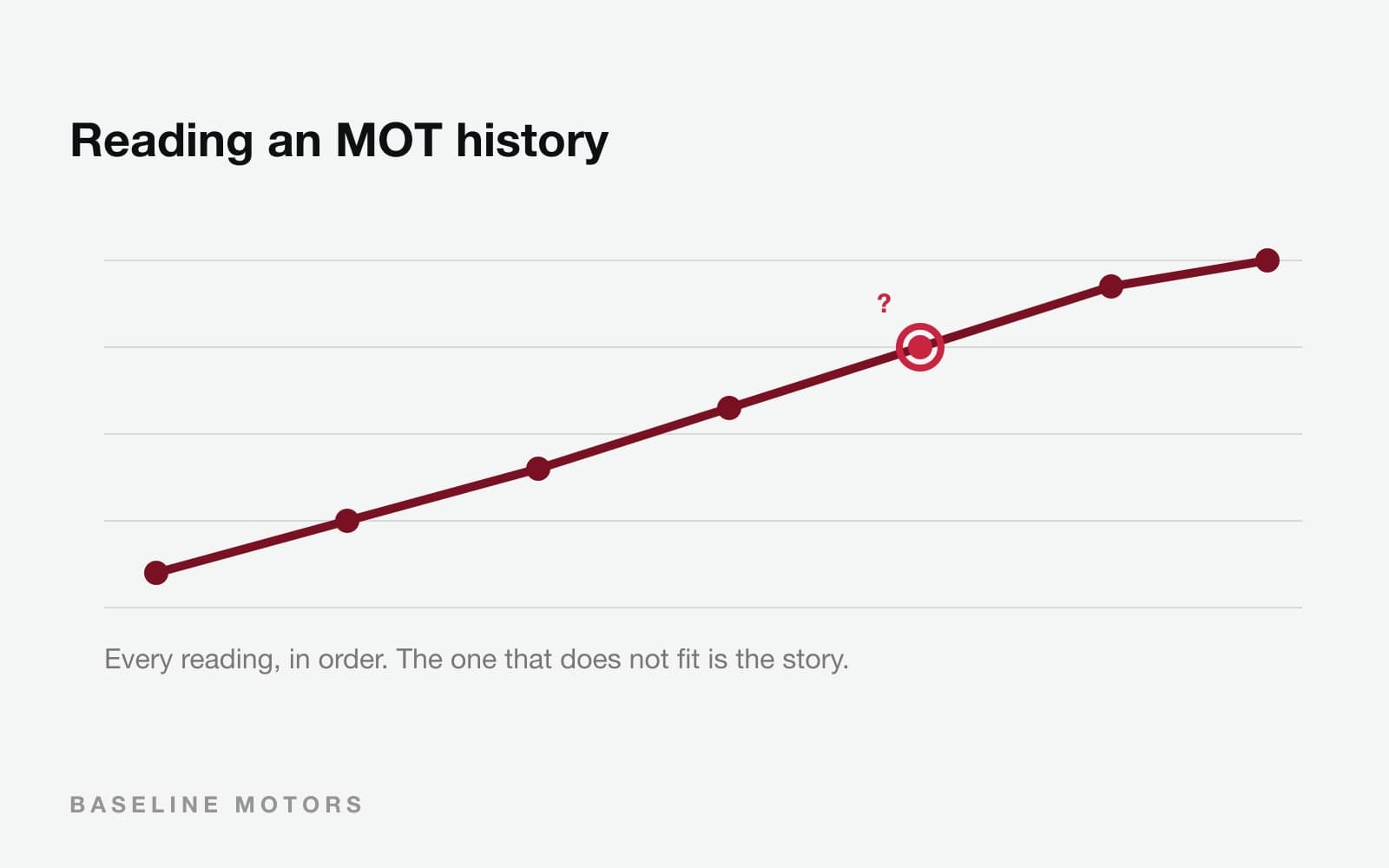
The MOT history is free, public, and the most useful thing you can read about a used car. It is also the thing most buyers skim for a pass or a fail and then close.
Read properly, it tells you how a car has been treated for its whole life — and it is very hard to fake, because it is the tester's record rather than the seller's.
You can look up any registration at gov.uk/check-mot-history. Here is what to actually look for.
Start with the mileage, not the results
Every MOT records the odometer reading. Put them in order and you have a graph of the car's life.
What normal looks like: a steady climb, roughly 6,000 to 12,000 miles a year, with the gaps between tests broadly consistent.
What should stop you:
- A reading that goes down. Mileage does not decrease. Either the clock has been wound back, the cluster was replaced, or someone typed it wrong. All three need an explanation.
- A sudden flat spell. Three years at 2,000 miles a year on a car that previously did 12,000 usually means it sat somewhere, often unwell.
- A sudden jump. 30,000 miles in one year on a car that averaged 8,000 suggests it changed hands to a very different kind of use.
A car with 140,000 honest motorway miles is frequently a better buy than one with 70,000 stop-start town miles. The number matters less than the shape.
Then read the advisories, not the passes
A pass tells you the car met the minimum standard on that day. The advisories tell you what the tester was worried about — and that is the interesting part.
Look for the same advisory appearing year after year. "Nearside front tyre worn close to the legal limit" once is a tyre. The same advisory three years running means nobody has fixed it, and that tells you how the car has been looked after.
Watch particularly for advisories that recur and escalate: corrosion noted, then corrosion advisory, then corrosion failure. That is a car rusting on a schedule.
Failures are not automatically bad
A failure followed by a pass a day or two later is completely normal — the car went in, something failed, it was fixed, it was retested. That is the system working.
What is worth a question is a failure followed by a long silence, then a pass months later at a different tester. Or repeated failures for the same item.
Also look for dangerous defects. Since 2018 defects are graded, and a "dangerous" marker means the car should not have been driven away. One is not damning. A pattern is.
Look for the gaps
An MOT is required annually once a car is three years old. A missing year means one of three things: the car was off the road, it was SORN, or the history has a hole in it. All are worth asking about, and the answer is usually mundane. But ask.
Cross-check against the service history
If the seller shows you a service book with a stamp at 90,000 miles in June 2022, and the MOT that month reads 74,000, one of those documents is wrong. This is the single easiest way to catch a doctored history, and almost nobody does it.
What we do with it
We publish the complete MOT history on every listing — every pass, every failure, every advisory, every mileage reading, pulled straight from the DVSA. Not a summary, and not just the good years.
We do it because the alternative is asking you to take our word for the condition of a car we bought at auction, and there is no reason you should. It also means the awkward conversations happen before you drive over rather than after.
If a listing anywhere does not show you the MOT history, it takes thirty seconds to look up yourself. Do it before you travel, not after.