
What Cat S and Cat N actually mean when you're buying
A write-off marker is an insurance decision about money, not a verdict on whether the car is sound. What the categories mean, what they do to the price, and when buying one makes sense.
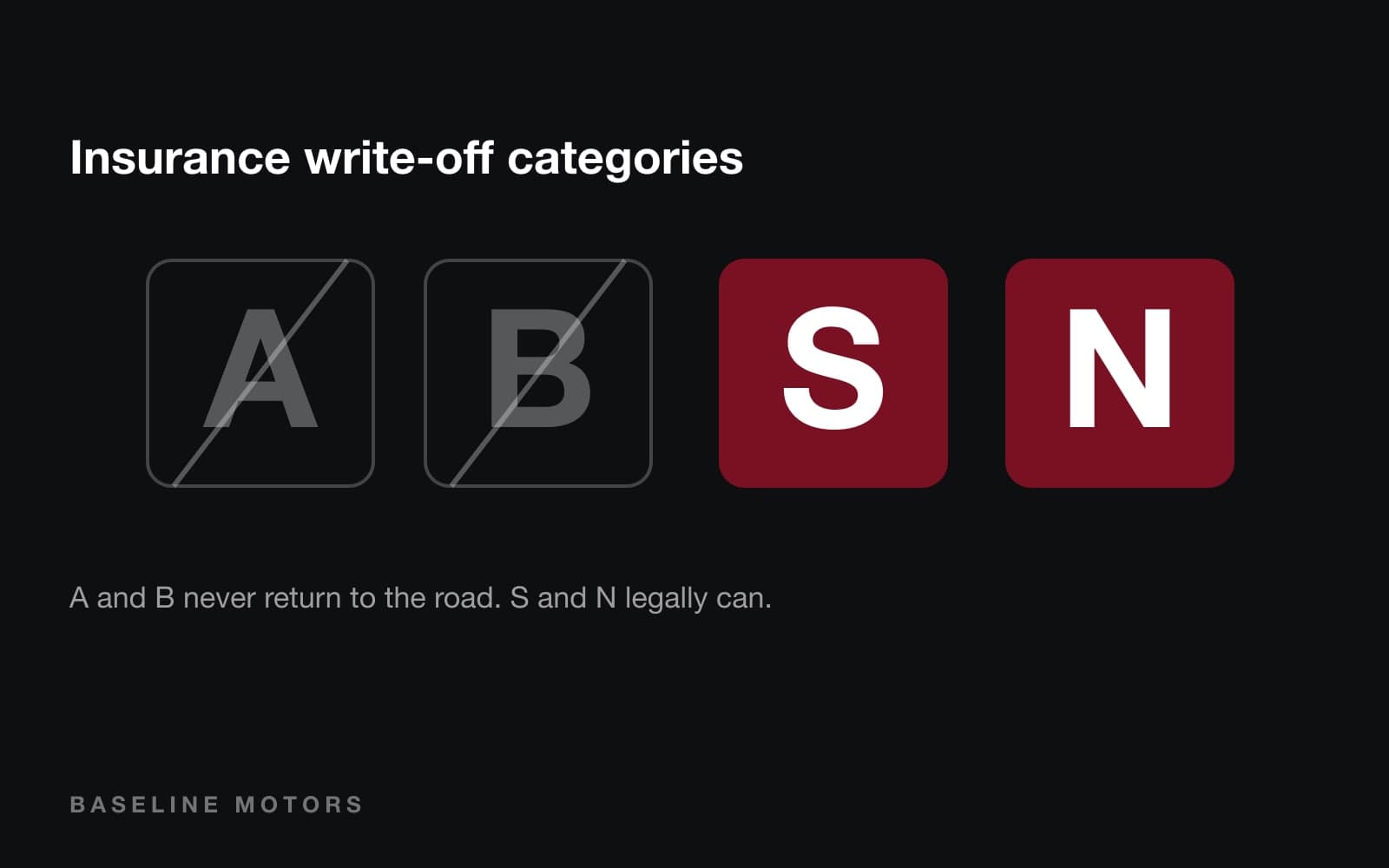
Walk down any list of cheap used cars and you will find some priced well below everything comparable. Often the reason is a letter: the car is a Category S or Category N insurance write-off. The advert may say so plainly, or it may not say so at all.
Here is what those letters mean, what they do to a car's value, and when buying one is sensible rather than reckless.
What a write-off actually is
A write-off is an insurance decision, not a mechanical one. When a car is damaged, the insurer compares the cost of repair against the value of the car. If repairing it costs more than the car is worth, they pay out and record the car on a national database. That record stays with the registration for ever.
The critical thing to understand: it is a decision about money, not about whether the car can be repaired properly. A three-year-old car with a scratched bumper is repaired. A twelve-year-old car with the same damage is written off, because the bumper costs more than the car.
The four categories
Category A — scrap. The entire vehicle must be crushed, including the parts. It will never legally return to the road.
Category B — the body shell must be crushed, though salvageable parts can be reused. Also never returns to the road as a car.
Category S — structural damage that has been repaired. Something in the chassis, suspension mounting or crumple structure was damaged. It can legally be returned to the road once repaired.
Category N — non-structural damage that has been repaired. The shell was not affected. This is often cosmetic, electrical, water damage, or a theft recovery.
If a dealer offers you a Cat A or Cat B car, walk away and report it. Those two cannot lawfully be sold to drive.
The old categories: C and D
Before October 2017 the equivalents were Category C and Category D, and they were based on repair cost rather than the type of damage. Any car written off before that date still carries the old letter, so you will see all four on older stock. Roughly, C maps to S and D maps to N — but not exactly, because the basis for the decision changed.
What it does to the price
A recorded write-off is typically worth 20 to 40 per cent less than the same car without the marker, and the gap is wider on Cat S than Cat N. That discount does not go away. When you come to sell, the next buyer will apply the same discount, and they will find the marker on their own check.
So the saving is real, but it is a saving you give back later. The people for whom it works best are those planning to run a car until it dies, because the resale discount never lands on them.
Insurance and finance
Two practical things catch people out.
Some insurers will not cover a Cat S car at all, and others load the premium. Get a quote before you commit, not after — this is the single most common reason a write-off purchase falls apart.
Finance is also harder. Many lenders will not fund a recorded write-off, and those that do may want a bigger deposit.
When it is a reasonable buy
A Cat N car with cosmetic damage properly repaired, bought at a genuine discount, from a seller who volunteers the category without being asked, is often good value. Theft recoveries in particular are frequently Cat N with very little wrong with them.
A Cat S car needs more care. Structural repair varies enormously in quality, and the difference between a proper jig repair and a bad one is not visible in photographs.
What to check before you buy one
- Ask why it was written off. A seller who does not know, or will not say, is telling you something.
- Get the repair evidence. Invoices, photographs of the damage before repair, and who did the work.
- Have it inspected. On a Cat S especially, pay someone independent. It is £100 or so against a car that could be unsafe.
- Check the panel gaps and paint. Uneven gaps, mismatched paint depth and overspray on rubber seals all point to a hurried repair.
- Get an insurance quote first.
How we handle them
We do buy and sell recorded write-offs, because they are cheaper and some buyers specifically want them. Where we do:
- The category is on the advert, in the specification and in the callout on the listing page.
- It is on the invoice you sign.
- We tell you in person before you spend an afternoon travelling.
We will never sell you a car with outstanding finance or a stolen marker, and we never take a Cat A or Cat B. But a properly repaired Cat N at the right price is a good car for the right buyer, and pretending otherwise would just mean fewer cars we can offer you.
If a dealer will not tell you the category, assume there is one.